
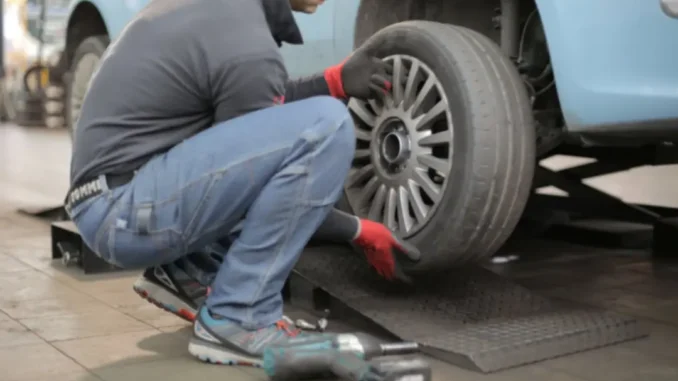
Are your drives shaking at highway speeds? Wheel balancing evens weight around a wheel-and-tire assembly so it spins smoothly without vibration. Read on to learn why it matters.
What Is Wheel Balancing?
What does “balanced” mean here? A wheel is balanced when its center of gravity matches the axis of rotation, so it spins without wobble. That is the basic idea.
Why are wheels rarely perfect? Tires and rims are never exactly uniform or perfectly round, so small heavy spots naturally appear. Imbalance is normal.
How does balancing fix the problem? Technicians use a machine to find heavy spots and then add small weights opposite those spots. That restores equilibrium.
How Wheel Balancing Is Done
Want a quick overview? A shop mounts the wheel on a spin balancer, measures the imbalance, then adds weight where needed. Simple steps follow.
How the Wheel Is Mounted
The wheel-and-tire assembly is placed on a spindle and centered. This ensures the machine measures the real imbalance, not a mounting error. Good mounting matters.
How the Wheel Is Measured
The balancer spins the wheel and reads vibration and angle sensors. It calculates how much weight to add and exact placement on inner or outer rim planes. Precision is key.
How Weights Are Added
Technicians attach clip-on or adhesive stick-on weights to the rim. The machine then rechecks the wheel to confirm balance is within tolerance. Final check completes the job.
Types of Balancing Weights
Clip-on weights fit metal rims easily. Adhesive weights work well for alloy rims and hidden mounting surfaces. Choose the proper type.
Wheel Balancing vs. Wheel Alignment
Confused about the difference? Balancing adjusts weight distribution, while alignment adjusts wheel angles like toe and camber. They are separate services.
Which symptoms point to which issue? Vibration at speed usually means unbalanced wheels. Pulling to one side usually means poor alignment.
Why Wheel Balancing Is Important
Want a smoother ride? Balanced wheels reduce vibration felt in the steering wheel, seat, and floor, improving comfort. That improves daily driving.
Reduces Vibration and Improves Comfort
Vibration happens when heavy spots make the wheel hop as it spins. Balancing evens mass and smooths rotation, reducing driver fatigue. Comfort improves noticeably.
Extends Tire Life
Unbalanced tires wear unevenly and develop cupped or scalloped tread patterns. Balanced wheels promote even wear and extend usable tread life. You save money over time.
Protects Suspension and Steering Parts
Constant vibration stresses shocks, struts, and wheel bearings. Balancing reduces those forces and preserves suspension health. Repairs may be avoided.
Improves Handling and Safety
Balanced wheels maintain steadier road contact, improving traction and steering control. That leads to more predictable handling and safer responses in emergencies. Safety increases.
Can Improve Fuel Efficiency
Imbalance can raise rolling resistance slightly. Proper balancing reduces wasted energy and can help fuel economy, especially on long trips. Small gains add up.
When and How Often Should Wheels Be Balanced
When should you act? Balance wheels when new tires are mounted, after repairs, or when you feel vibration. Those are the main triggers.
How often is routine balancing needed? Many shops recommend balancing at each tire change or every 10,000–12,000 miles. Check conditions and driving habits.
Symptoms of Unbalanced Wheels
How can you tell wheels are unbalanced? Common signs include steering-wheel shake, seat vibration, and uneven tire wear. Here are specifics.
Steering wheel vibration usually indicates front-wheel imbalance. Seat or floor vibration often signals rear-wheel issues. Listen and feel for the location.
Look for cupped or scalloped tread wear. That pattern indicates repeated high-load spots on the tire. It points to imbalance or suspension problems.
Real-World Examples
Ever notice a car that trembles at 60 mph? That is often an unbalanced wheel, especially after a new tire was fitted poorly. A quick shop visit fixes it.
What about hitting a pothole? A hard impact can knock off wheel weights or bend the rim, causing imbalance. Balancing and inspection bring things back to normal.
DIY Balancing and Costs
Can you balance at home? Basic re-centering or replacing lost weights is possible, but accurate balancing needs a machine. Most people use a shop.
What about cost? A typical balancing job is quick and inexpensive compared to tire or suspension replacement. Value is high.
Conclusion
What should you remember? Wheel balancing evens mass around the wheel so it rotates smoothly, reducing vibration and wear. Balanced wheels protect tires, suspension, fuel economy, and safety.
When in doubt, have a shop check the wheels. A brief balancing can prevent bigger, costlier problems later. Stay smooth on the road.
Leave a Reply