
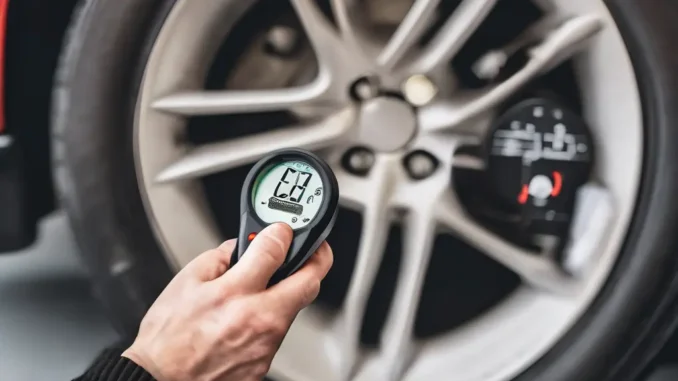
I’ve been changing my own tyres and checking pressures for years. One simple habit that’s saved me money, improved fuel economy, and kept my family safer is keeping tyre pressures exactly where the vehicle manufacturer says they should be. If you’re asking “what is the correct tyre pressure for my car,” I’ll walk you through exactly how to find it, how to check and adjust it, and what mistakes to avoid—based only on trusted manufacturer and safety guidance.
Why the vehicle spec matters (not the tyre sidewall)
I once saw a driver inflate their tyres to the number stamped on the tyre sidewall—44 PSI—because they assumed higher is better. That’s the tyre’s maximum, not the recommended setting for your car. Your vehicle manufacturer decides the best pressure to balance load, handling, braking and ride comfort. You’ll find that number on a placard on the driver’s door jamb, in the glove box, fuel door, or in the owner’s manual (see Firestone and Discount Tire for examples).
Cold pressure vs hot pressure — the single key rule
Always check tyre pressure cold. “Cold” means the car hasn’t been driven for at least three hours or has been driven less than about a mile slowly. Driving or sun exposure raises the tyre’s internal temperature and typically increases pressure by 4–6 PSI; a useful rule of thumb is roughly 1 PSI change for every 10°F change in ambient temperature. So a tyre that reads 36–38 PSI after driving might be set to a 32 PSI cold spec.
Where to find the correct number for your car
The correct tyre pressure for your car is on the vehicle placard or in the owner’s manual. Common placard locations:
- Driver’s door jamb / door post (most common and reliable)
- Glove box or fuel door
- Owner’s manual
That placard shows cold PSI for the front and rear, and sometimes for “loaded” or heavy-load conditions. If you use online charts (like Firestone’s or Discount Tire’s tools), always verify the final number with your car’s placard or manual.
Typical ranges and conversions
Most passenger cars fall between 28–36 PSI cold. Depending on the car, front and rear pressures may differ by a few PSI. If you prefer metric: 32 PSI ≈ 220 kPa ≈ 2.2 bar.
Step-by-step: how I check tyre pressure (do this monthly)
I check my tyres once a month and before long trips. Here’s the routine I use:
- Park on level ground and let tyres cool (3+ hours if possible).
- Remove valve cap and press a good digital or stick gauge firmly onto the valve stem; the hiss is normal.
- Read the PSI and compare with your vehicle placard.
- Add air with a compressor if low, in short bursts, then recheck. If over, press the valve core gently to release a little air.
- Check all four tyres and the spare if your car has a full-size spare.
- Replace valve caps.
Tools I recommend
- A reliable digital tyre gauge (service-station gauges can be inaccurate).
- A portable compressor with a preset PSI stop if you fill at home.
- Keep the valve caps on—small and cheap insurance.
Why correct pressure matters — real consequences
I’ve driven with a tyre a few PSI low before and immediately noticed softer handling. Below are the practical outcomes you’ll see if you don’t keep pressures right:
- Under-inflation: causes excessive sidewall flex, edge wear, heat buildup, poorer braking and cornering, higher hydroplaning risk, and can eventually lead to a blowout. U.S. TPMS (tire pressure monitoring systems) only alerts at about 25% under-inflation, so small drops still matter.
- Over-inflation: makes the ride harsh, increases center tread wear, reduces road contact and grip, and makes tyres more vulnerable to pothole damage.
Small pressure changes affect fuel economy and tyre life
Keeping tyres at the recommended pressure improves fuel efficiency (NHTSA cites potential savings up to a few percent) and helps tyres wear evenly—saving you money and increasing safety. For optimal performance, it’s also important to understand how to choose the best engine oil grade for your car.
Common mistakes I see drivers make
- Using the tyre sidewall number as the vehicle pressure. That’s the tyre’s max PSI; ignore it for daily use.
- Trusting visual inspection alone. Tyres can be 20% under-inflated and still look OK.
- Letting service-station compressors overshoot. Always recheck with your own gauge.
- Forgetting the spare. It can sit flat and be useless in an emergency.
- Checking when tyres are hot and adjusting to a hot reading—measure cold, or subtract ~4 PSI if you must check hot.
Special situations: loads, weather and mods
- Heavy loads: check the placard for higher cold PSI settings for loaded conditions (some cars list separate “max load” pressures).
- Cold weather: tyre pressure typically falls about 1 PSI per 10°F drop—top up more often during a cold snap.
- After changing wheel or tyre sizes: follow the vehicle manual or consult a tyre professional—don’t assume the factory PSI still applies without verification.
A simple real-world example
On a 215/60R16 tyre on my old hatchback the placard recommended 32 PSI front and rear. I once filled to 36 PSI after checking hot at a petrol station and felt an uncomfortable, skittish ride. I let 4 PSI out and the car returned to the planted, predictable behaviour it had at 32 PSI cold. That’s why cold checks matter.
Quick answers to the question “what is the correct tyre pressure for my car”
- Find the placard on your car or consult the owner’s manual—use that exact cold PSI number.
- Most passenger cars: 28–36 PSI cold.
- Measure cold (3+ hours of rest) or subtract about 4 PSI from a hot reading.
- Use a reliable gauge and check monthly (and before trips).
See also: How often should I service my car
Final takeaway from someone who’s tested it
If you want one action right now: walk to your driver’s door jamb, read the cold PSI on the placard, and keep your tyres at that number (check them with a good gauge monthly). It’s a tiny habit that makes your car safer, smoother, and cheaper to run.
Leave a Reply