
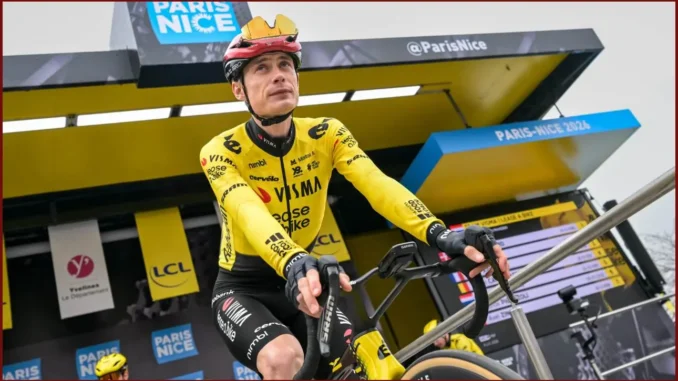
After missing the UAE Tour due to illness, Jonas Vingegaard got his 2026 season up and running on what he described as a “stressful” opening stage at Paris-Nice. The Dane made what should have been a straightforward comeback on the roads of northern France, but the opening stage left him with more than just race nerves—he had a serious bone to pick with the race organizers.
A Stressful Return
Vingegaard rolled home in the peloton on a stage won in a bunch sprint by Luke Lamperti, but the real story wasn’t about the winner or the final GC standings—it was about what happened along the way. There were a lot of crashes that day, and Vingegaard hoped everyone was okay. The tension was palpable, the nerves were high, and Vingegaard was thinking he hoped that all race days weren’t going to be like this, because then it would be terrible.
But this wasn’t just about the crashes or the general stress of racing after time off. Vingegaard had spotted the real culprit: the quality of the roads themselves.
Aiming at the Organizers
In particular, Vingegaard pointed to the condition of the road on the Côte de Chanteloup-les-Vignes, which was the key feature on the local lap in the finale of the stage. And when journalists asked him about his concerns, he didn’t hold back. He didn’t think it was worthy of a WorldTour race, citing bad roads, constantly right and left turns, potholes, and especially the last descent, which riders navigated three times and “wasn’t good enough for a WorldTour race.”
The critique was aimed directly at Amaury Sport Organisation (ASO), the organizers behind Paris-Nice and the Tour de France itself. This was no casual observation from a fatigued rider—this was a genuine professional complaint about the standards expected at the sport’s highest level.
A Veteran’s Perspective
The Danish rider did not stay silent regarding what he felt was a route that put the riders in danger, and shared that several of his colleagues felt the same way at the opening stage of Paris-Nice. This wasn’t just Vingegaard being fussy or perhaps overly cautious after his year out. His teammates agreed, other riders in the peloton shared his concerns, and the conditions were legitimately problematic.
When pressed on whether he was simply getting older and more sensitive to rough conditions, Vingegaard acknowledged the possibility with characteristic humor. He said “Maybe I’m getting old. I don’t know. But I talked to some people out there, and they said that fortunately not all races have been like this.” In other words: his concerns weren’t unfounded, and they weren’t coming from one sensitive rider—they were coming from across the peloton.
The Real Issue
The finale saw a number of nervous crashes, and Vingegaard was one of many held up behind Lenny Martinez’s fall in the final kilometre, though without any consequence for his general classification hopes. The crashes weren’t accidents born of aggressive racing or tactical errors—they were consequences of negotiating substandard road surfaces at speed in a tightly packed bunch.
For someone making his comeback after illness and injury, Vingegaard had every reason to be frustrated. He wasn’t complaining to be difficult or to make excuses. He hoped the rest of the week wouldn’t be like that either. His message was clear: Paris-Nice 2026 started with ASO delivering something that simply didn’t meet the standards of professional WorldTour racing, and the Visma-Lease a Bike leader wasn’t going to stay silent about it.
Leave a Reply