
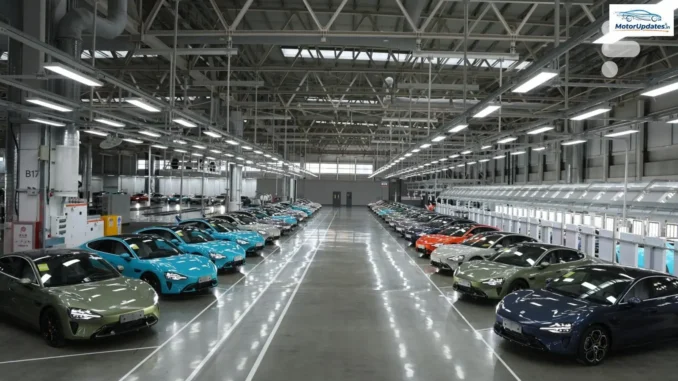
Can a smartphone giant become a major carmaker? Xiaomi reached 500,000 electric vehicles in under two years. This article explains how they did it.
How Xiaomi reached 500,000 cars so fast
How did Xiaomi scale so quickly? The company combined heavy automation, clear product choices, and fast factory builds. The result: a high-volume Xiaomi electric car program.
High-speed production lines
What makes the assembly lines special? They use more than 700 robots to automate key steps from stamping to final assembly. This automation lets Xiaomi claim a finished vehicle every 76 seconds.
Automation: 700+ robots and a 76-second cycle
Think of the line like a clock. Each robot performs a repeated task with precision, cutting errors and speed losses. The 76-second rhythm means huge daily output.
Factory capacity and scale
How big are the plants? Two initial factories can produce over 60,000 cars per month at full speed. New plants arriving in 2026 will push capacity toward 1.2 million units annually.
Product strategy: SU7 and YU7
Why do buyers choose Xiaomi EVs? The SU7 sedan and YU7 SUV offer strong features for their price. These models sit above 250,000 yuan and target buyers seeking premium features without premium prices.
Pricing and positioning
What is Xiaomi’s pricing edge? Competitive costs and integrated software lower perceived value gaps. Even with higher European prices, the cars may still undercut rivals on features per euro.
Financial performance and profitability
When did Xiaomi become profitable in cars? The company reached profitability in September 2025, 17 months after first deliveries. Analysts estimate Q3 profits near 700 million yuan, a rapid turnaround compared to many EV startups.
Key financial milestones
How fast is that versus others? Li Auto took about four years to break even. Xiaomi’s pace is unusually fast in the Chinese EV market. Rapid scale and tight cost control explain much of the difference.
Production timeline and numbers
What were the key volume milestones? It took only 230 days to make the first 100,000 cars. Monthly outputs now often exceed 40,000, with October topping 48,654 units.
Targets and future milestones
Is 1 million cars realistic by 2026? Xiaomi aims for the millionth vehicle around August 2026. New factories and continued automation make that target plausible.
Manufacturing and automation details
How do the lines work step by step? Processes include stamping, die casting, welding, painting, and final assembly. Robots handle most repeatable tasks to keep throughput high.
Processes explained simply
Imagine a bakery making identical loaves. Machines mix, shape, and bake without pause. In the same way, Xiaomi’s production minimizes manual variation.
Supply chain and logistics
Where do parts come from? Xiaomi leverages suppliers in China and close partnerships for batteries, electronics, and body parts. Solid supply relationships shorten lead times and reduce costs.
Expansion plans and global ambitions
Will Xiaomi stay in China only? No. The company plans to enter Europe in 2027. The rollout will include adjustments for safety rules and import costs.
New plants and capacity growth
Which new sites are coming? Two more factories, including one in Wuhan, will start in the second half of 2026. These sites are key to reaching 1.2 million annual capacity.
Adapting for Europe
How will European cars differ? They will need additional certification and safety features. Prices will rise, but Xiaomi’s value proposition should remain strong.
How Xiaomi differs from other tech car attempts
Is this just another tech firm trying to make cars? No. Xiaomi combined hardware know-how, manufacturing partners, and an existing retail and service network. That mix is different from one-off concept projects.
Lessons from Sony, Apple, and others
What about past failures? Sony and rumored Apple projects showed how hard carmaking can be. Xiaomi avoided those pitfalls by committing factories and production expertise, not just branding.
Why Xiaomi succeeded
What were the decisive factors? Deep automation, clear model lineup, aggressive capacity expansion, and price-performance strategy. Those elements together produced rapid scale and early profits.
What this means for the EV market
Will other automakers feel pressure? Yes. Faster, cheaper, and feature-rich models push competitors to improve efficiency. Consumers may get better value and more choice.
Market implications
Could prices fall across segments? Increased competition often lowers prices or raises equipment levels. Established brands must adapt or lose share.
See also: Peugeot’s Electric Future Hypersquare Steering and Neo-Retro Design
Potential risks
Are there downsides to rapid growth? Fast expansion can strain suppliers and quality control. Xiaomi must balance speed with long-term reliability and service.
Conclusion
Xiaomi reached 500,000 electric vehicles quickly by combining heavy automation, focused models, and rapid factory expansion. The result is high output, early profitability, and a clear plan to scale globally. Watch for European launches in 2027 and continued pressure on the EV market.
Leave a Reply