
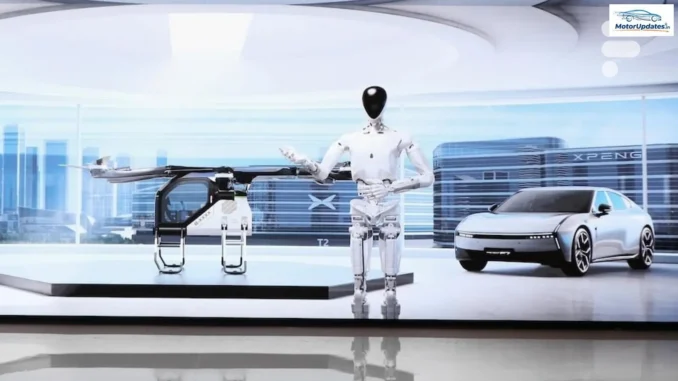
Have you ever seen robots and flying cars in the same place?
At Xpeng’s campus in Canton, futurism felt tangible.
I toured the facility and watched prototypes move and fly.
IRON Next‑Gen: A Humanoid That Blurs Boundaries
What makes a robot feel human?
The IRON Next‑Gen aims to answer that question.
Its motion and look push the line between machine and person.
Design and Mechanics
How many joints does a robot need to move like us?
IRON packs 82 degrees of freedom, focusing on key limbs and hands.
That lets it mimic many human gestures and object handling.
What about size and shape?
The robot is 173 cm tall and weighs about 65 kg.
Xpeng offers different body types and gendered silhouettes, sparking debate.
Hands, Spine, and Muscles
Do realistic hands matter?
IRON has 22 DoF in each hand to reproduce detailed grips.
It also uses a humanoid spine and bionic muscles to enable lifelike posture.
Think of the robot like a marionette with many more strings.
More strings mean better motion but tougher control.
Skin and Tactile Sensing
Can a robot feel touch?
IRON’s body uses a layered build: skeleton, muscles, then synthetic skin.
Tactile sensors are woven into the outer layer to sense pressure and contact.
The skin resembles perforated latex.
It helps the robot interact more gently with objects and people.
Brains and Powertrain
How smart is the IRON inside?
It runs three Turing AI chips delivering about 2,250 TOPS of compute.
The robot uses Xpeng’s VLT model for vision, language, and task planning.
What about energy?
IRON carries a 2 kWh solid‑state battery.
Solid batteries promise more safety and energy density than liquid cells.
Limits and Practical Use
Is it ready for everyday tasks?
Movements can still be jerky over long walks.
Arm and hand motions are convincing for close work and demonstrations.
Could it help at home?
With learning from human motions, the robot could handle chores.
Yet real‑world deployments need more testing and mass data.
Anthropomorphism as Strategy
Why make robots look human?
Xpeng argues human form simplifies real‑world tasks and data gathering.
A familiar shape helps adapt tools and spaces designed for people.
But will everyone accept humanoid robots?
The approach raises ethical and cultural questions.
Public perception will shape adoption as much as tech does.
ARIDGE: Xpeng’s Low‑Altitude Air Mobility
Can cars really fly soon?
Xpeng’s ARIDGE unit builds two low‑altitude systems for personal and multi‑passenger use.
They mix automotive production know‑how with aeronautical design.
Land Aircraft Carrier: Practical Short‑Range Flight
What is the Land Aircraft Carrier?
It’s a compact vertical‑takeoff vehicle designed for two people.
The craft docks into a six‑wheel carrier for ground travel.
Is it near production?
Orders top 7,000 units, mainly in China and the UAE.
Xpeng plans simulators and short certification courses for buyers.
How is control simplified?
The vehicle uses a single‑stick interface to ease piloting for novices.
Redundant systems and a six‑rotor layout boost safety against failures.
A868 Tilt‑Rotor: Longer Range Ambitions
What about longer trips?
The A868 is a tilt‑rotor design aimed at around 500 km range.
Top cruise speed could reach about 360 km/h.
Who is it for?
Its six‑seat cabin targets business travel between urban hubs.
This project is still under development and certification.
Production, Regulation, and Safety
Where will these be made?
ARIDGE started trial production and built a first Land Aircraft Carrier.
Initial annual capacity targets range from 5,000 to 10,000 units.
What blocks mass rollout?
Permits, airspace rules, and local licenses remain hurdles.
Cities must adapt regulations before flights become routine.
Use Cases: Tourism First, Cities Later
Who will use flying cars first?
Xpeng focuses on tourism and rural routes, not dense city transit.
Think scenic flights and remote sightseeing rather than daily commutes.
Why tourism?
Permits and route coordination are simpler outside urban zones.
Some regions plan dedicated tourist air routes by 2026.
See also: How Xiaomi Produced 500000 Electric Vehicles in Record Time
Conclusion
Are we living in sci‑fi or reality?
Xpeng’s IRON and ARIDGE show both.
Robots now mimic human gestures with many joints and tactile skin.
Flying vehicles are moving from prototypes toward limited production.
Regulation, training, and public acceptance will decide the pace of change.
Key takeaway: the future is taking shape at Xpeng.
It will arrive step by step, not all at once.

Leave a Reply