Lidl Breaks New Ground: Fully Autonomous Electric Truck Delivers to Stores Without a Driver

Lidl Launches Groundbreaking Test with Fully Autonomous Electric Truck for Store Deliveries
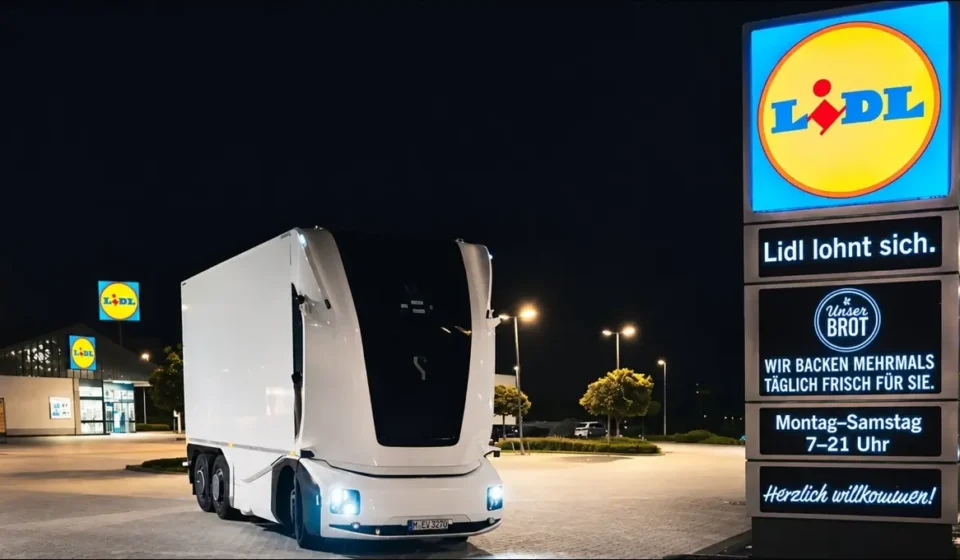
In a major step toward revolutionizing retail logistics, German supermarket giant Lidl has begun using a completely driverless electric truck to deliver goods directly to one of its stores. Partnering with Swedish autonomy specialist Einride, this pilot project marks a first for food retailers in Germany, operating on public roads without any human operator on board.
Testing Autonomous Deliveries in Edermünde
The trial is taking place in Edermünde, a town near Kassel in central Germany. The route is a modest 400 meters from a nearby distribution center to the store, but it’s significant because it runs on open public roads. Lidl secured special approval from Germany’s Federal Motor Transport Authority (Kraftfahrt-Bundesamt), highlighting the rigorous safety standards met.
Einride’s Pod Gen-2, a cabless electric truck designed purely for freight, handles the job. Without traditional controls like steering wheels or pedals, the entire front space maximizes cargo capacity. Each run transports 15 pallets of groceries, with the truck completing up to three trips daily. Over the four-month test period, the goal is to deliver more than 3,000 pallets seamlessly.
Safety Measures and Real-World Operations
While fully autonomous, the truck is shadowed by a support vehicle carrying a Lidl employee, a regulatory requirement for this initial phase. Loading and unloading are still manual, and speeds are capped at 25 km/h to prioritize safety. These constraints ensure compliance while gathering valuable data on performance in everyday conditions.
Thomas Dangelmayer, Lidl Germany’s head of operational logistics, emphasized the efficiency gains: “Smart technology drives efficiency, ensuring reliable product availability for customers long-term.”
Einride’s CEO, Roozbeh Farhadi, praised the milestone: “Germany’s approval process is among the world’s strictest. This success builds a strong foundation for scaling up autonomously.”
Scaling Up: Phase Two and Beyond
Lidl plans a second phase in 2027, extending routes beyond 400 meters and including multiple store stops. As part of the Schwarz Group—which also runs Kaufland—the retailer is exploring broader integration of AI and autonomy across its supply chain.
This push addresses Germany’s looming driver shortage, with forecasts predicting over 100,000 vacancies for truck and bus drivers by 2030. Autonomous vehicles offer a sustainable solution, cutting emissions and operational costs while boosting reliability.
German Transport Ministry official Christian Hirte noted: “Emission-free, autonomous driving is no longer a distant dream—it’s happening on our roads today.”
Benefits and Future of Retail Logistics
For retailers like Lidl, autonomous trucks promise transformative advantages:
- Cost Savings: Reduced labor needs in a tight market.
- Eco-Friendliness: Zero-emission electric power aligns with green goals.
- 24/7 Operations: Potential for round-the-clock deliveries without fatigue risks.
Practical example: In urban areas with short-haul routes, like distribution centers near stores, these trucks could slash delivery times and fuel use by 30-50%, based on similar pilots elsewhere.
Challenges remain, including scaling to longer distances, full regulatory approval for unsupervised runs, and proving economic viability. Yet, Lidl’s test demonstrates that driverless logistics are viable now, paving the way for widespread adoption.
As autonomy tech matures, expect more grocers to follow, reshaping how fresh goods reach shelves efficiently and sustainably.